
Key Takeaways
- Long end led, then retraced. 30-year yields set multi-year highs in the US, Germany and Japan before pulling back into month-end. A Treasury buyback expansion capped the long end while a hawkish Jackson Hole lifted the front end, flattening 2s10s to roughly 40bp.
- We fade the September hike. Markets ended August pricing a hike close to a coin flip. We think a cooling labour market and the supply-side nature of the current inflation impulse leave the Committee less room than pricing implies. We expect no hike this year, and we size for the possibility that we are wrong.
- Financial repression is the organizing theme. Buybacks concentrated at the long end, gold up 9.8%, and a softer dollar all point the same way. Both the Treasury and the Fed are leaning on signals rather than actions.
- Intervention bought time, not a trend change. The yen operation was the largest in 15 years and the first executed jointly with the US Treasury in decades. Positioning has been washed out but the market is still net short yen, and reserves are falling at a record pace. The distribution is two-sided; we prefer to own volatility rather than direction.
- El Niño is confirmed and strengthening. NOAA now puts the odds of a very strong event above 90% through the 2026-27 winter. August already moved sugar, wheat and corn 17-21%, so entry level matters; we prefer crops with Southern Hemisphere supply exposure.
Market Overview
Risk assets pushed to new highs in August. The S&P 500 set a fresh record early in the month and finished 2.7% higher, with resilient second-quarter earnings and continued AI-related capital spending doing most of the work. The more consequential move, however, was in long-dated government bonds, where yields reached multi-year highs across several markets before retracing late in the month. The 10-year Bund touched a cycle high of 3.32%, while the 10-year Treasury reached 4.75%, its highest in well over a year.
Two forces were at work. A broad risk-on tone and renewed inflation concern pushed term premia higher, and the US Treasury then announced an expansion of its buyback programme in longer-dated debt. Rather than settling the market, that announcement reinforced the financial-repression narrative: gold rose 9.8%, its strongest month of the year, and the dollar index slipped around half a percent.
Agricultural markets moved sharply as El Niño conditions strengthened, with sugar up 21.4%, wheat up 18.3% and corn up 16.9%. Oil was the exception. Brent gained just 0.4%, its smallest monthly change this year, although it held near $90 a barrel with Middle East tensions unresolved — a live inflation input that we return to below. [1]
Rates
The defining move of the month was the global rise in long-dated yields. The US 30-year Treasury yield reached a post-2007 high of 5.31% on 17 August, Germany’s 30-year hit a post-2011 high of 3.81% on 31 August, and Japan’s 30-year touched 4.14% on 18 August — the highest since that maturity was first issued in 1999.
Long yields then pulled back into month-end. The trigger was the Treasury’s unexpected announcement on 19 August that it would at least double the size of its buyback operations in 10- to 30-year debt, from roughly $2bn to $4bn or more per operation.
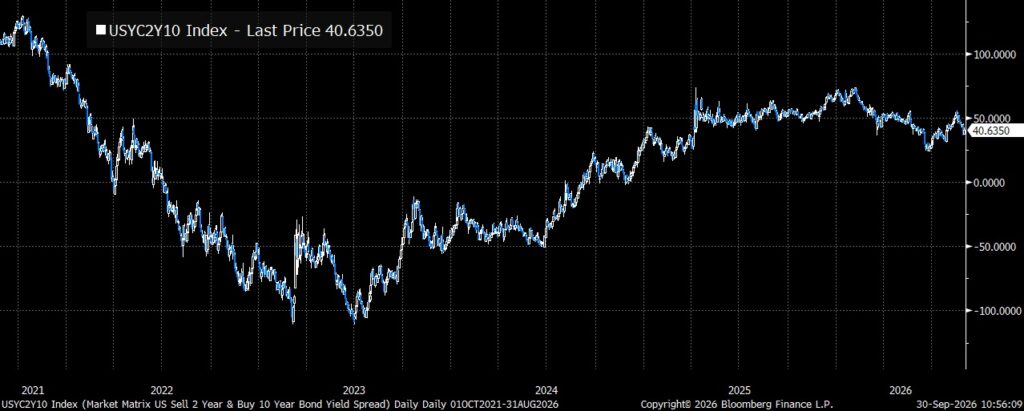
Fed Chair Warsh’s Jackson Hole keynote on 28 August compounded the move, but at the other end of the curve. He struck a more hawkish tone than expected, framing the 2% inflation objective as a firm and fixed target and declining to rule out further tightening. Short-end yields rose, the long end barely moved, and 2s10s flattened to roughly 40bp. Markets ended the month with a September hike close to a coin flip: fed funds futures in the mid-to-high 50s, prediction markets nearer 50%.
Chart 1: US 2s10s spread (bp) [2]
Our view: the Fed does not hike this year, and we would fade the pricing.
- The growth impulse is weakening. The July payroll miss took September hike odds from the low 60s into the 30s before Warsh reversed them. A labour market that is cooling in a low-hire, low-fire equilibrium limits how far the Committee can practically go.
- The inflation impulse is largely supply-side. Energy and tariffs account for much of the overshoot. A policy rate does little to resolve either, and hiking into an energy shock tightens financial conditions without addressing the source.
- Warsh’s own framework argues against action. He has explicitly declined to offer forward guidance or submit a dot. Signalling that hikes are possible is cheap; delivering one against a softening labour market is not. On our reading, Bessent’s buyback expansion and Warsh’s rhetoric are two sides of the same coin — both attempts to contain the market with signals rather than actions.
We hold this view with appropriate humility. Core PCE at 3.3% remains well above target, three FOMC members dissented in favour of an immediate hike in July, and the August CPI print lands days before the decision. This is a close call, and it should be sized as one.
The expression we prefer is a structure that pays while the front end stays anchored. A daily range accrual referencing SOFR and the 10-year Constant Maturity Treasury (CMT10) accrues an enhanced coupon for each day both rates hold inside their bands. The trade-off should be stated plainly: the buyer is short volatility and short convexity on both legs, the coupon is capped, missed days are not recovered, and the issuer typically holds a call that truncates the good outcomes. It expresses a range-bound view, not a directional one, and the CMT10 leg carries the risk we describe above — a long end still driven by supply and term premium. We would size modestly ahead of the 16 September FOMC and set the CMT10 band wide.
Japanese Yen
Japan’s intervention, begun on 30 July and extended through August, was the largest in 15 years and, unusually, was executed jointly with the US Treasury, which sold euros to buy yen. Authorities spent ¥15.39tn between 30 July and 26 August — the largest monthly total on record — taking the cumulative figure for the year above ¥27tn. Foreign reserves fell 6.18% in August to $1.207tn, the fastest monthly decline since records began in 2000.
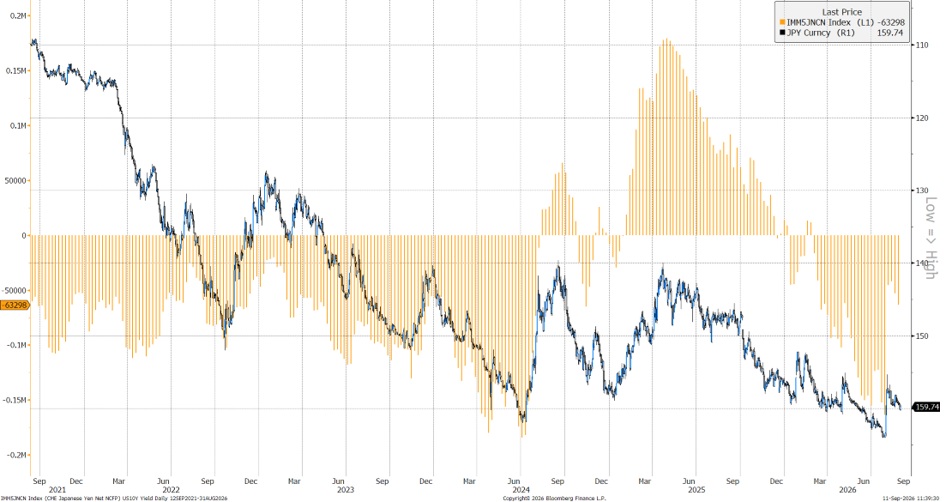
The operation forced a sharp reduction in tactical yen carry positions. CME net non-commercial positioning has moved from a deep short toward roughly −63k contracts, though the market remains meaningfully net short yen. USD/JPY has since climbed steadily back from 155.20 to just under 160, still short of the late-July low near 164. That grind reflects both the underlying depreciation pressure and persistent scepticism that Japan’s policy mix, or the broader macro backdrop, can shift enough to support the currency sustainably. Intervention buys time and washes out speculative positioning, but only for so long, and the reserve drawdown sets a practical limit on how often it can be repeated.
The counter-case is real, and has strengthened. Markets now price a BoJ hike at the 17 September meeting at around 60%, and a faster normalisation path could keep the yen supported without any shift in the global growth backdrop. US participation also changes the risk calculus for yen bears: a coordinated backstop raises the cost of being short, because the reaction function now includes Washington.
Our conclusion is that the distribution is genuinely two-sided and unusually wide. Historically, a durable yen rally has required the emergence of global growth concerns rather than intervention alone, and absent that we expect the drift back toward the lows to resume. But with the FOMC and the BoJ meeting in the same week, we would rather own the move than pick its direction. We remain cautious on yen carry, particularly against high-yielding EM such as BRL, where the funding leg and the asset leg can turn against the position simultaneously.
Chart 2: (inverted) JPY vs CFTC Net Position [3]
Positioning
Against this backdrop, we balance risk management with selective, tactical opportunities.
- Favour US front-end rates. Expressed through daily range accrual notes on SOFR and CMT10. Carry-positive while the front end stays anchored; short volatility and callable, so it suits a range-bound view rather than a directional one. Modest size, wide bands on the CMT10 leg.
- Long soft commodities. Futures in cotton, rice and sugar, ahead of El Niño-driven supply pressure that NOAA now assigns a greater than 90% probability of reaching very strong intensity through the 2026-27 northern winter. We favour crops with Southern Hemisphere supply exposure, where the El Niño signal is most reliable, and are less constructive on US corn, where El Niño years have historically been neutral to favourable for yields. Mind entry levels after August’s move, and mind roll liquidity in rice.
- Opportunistic long USD/JPY volatility. Own optionality rather than direction into a week containing both an FOMC and a BoJ decision. Check implied against realised before adding; August has already repriced vol, and the entry is less attractive than the thesis.
[1] All performance data is sourced from Bloomberg, dated on August 31 2026
[2], [3] Bloomberg
Disclaimer
The information presented here is intended for Accredited or Institutional Investors only and it does not constitute a recommendation to anyone; it also has not taken into account the specific investment objectives, financial situation or particular needs of any particular person. Information herein is based on sources we believe to be accurate and reliable as at the date it was made. We reserve the right to revise any information herein at any time without notice. No offer or solicitation to buy or sell securities, funds or products and no investment advice or recommendation is made herein. In making investment decisions, investors should not rely solely on this advertisement but should seek independent professional advice. However, if you choose not to seek professional advice, you should consider the suitability of the investment for yourself. Past performance of the fund manager, portfolios, and the funds are not indicative of future performance.
Investment involves risks including the possible loss of principal amount invested and risks associated with investment in emerging and less developed markets. The fund manager, portfolios, and the funds may invest in illiquid instruments, financial derivative instruments and/or structured products and be subject to various risks (including counterparty, liquidity, credit and market risks etc.). Investing in fixed income instruments (if applicable) may expose investors to various risks, including but not limited to creditworthiness, interest rate, liquidity and restricted flexibility risks. Changes to the economic environment and market conditions may affect these risks, resulting in an adverse effect to the value of the investment. During periods of rising nominal interest rates, the values of fixed income instruments (including short positions with respect to fixed income instruments) are generally expected to decline. Conversely, during periods of declining interest rates, the values are generally expected to rise. Liquidity risk may possibly delay or prevent account withdrawals or redemptions. Environmental, Social and Governance (ESG) strategies consider factors beyond traditional financial information to select securities or eliminate exposure which could result in relative investment performance deviating from other strategies or broad market benchmarks. Past performance, or any prediction, projection or forecast, is not indicative of future performance. The duplication, publication, extraction, or transmission of the contents, irrespective of the form is not permitted, except for the case of explicit permission by Aevitas Capital Management Pte. Ltd. This advertisement has not been reviewed by the Monetary Authority of Singapore (MAS).