
Key Takeaways
– AI trade reassessed. A positioning shakeout, but frictions cap the growth pace.
– Real yield structurally higher. Real yield curve steepening, bonds weaker ballast.
– Positioning. Buy leading semi/hyperscalers, local currency EMD, long gold and soft commodities.
Market Overview
Global markets faced several crosscurrents in July. Re-escalation between the US and Iran drove a renewed rise in oil, resulting brent crude to rise 23.6% as the best performing major asset. The reflationary backdrop weighted on global bonds, while the light-on-detail Fed decision added curve steepening pressure, leading the 30y Treasury yield to end July at a post 2007 high of 5.27%. A reassessment of the AI trade was the key theme
in equities, with the SOX index down 20.6%, seeing its worst month since 2008, and the KOSPI slumping 22.2% despite a late rebound. HSI had a strong gain of 12.3% in July, aided by investors regional rotation.
Japan became the focal point in FX markets at the end of the month. Apparent FX intervention on July 30 drove a rebound in the yen after it hit its weakest level against the dollar since 1986. This left the yen as the best performing G7 currency in July, +3.3% against the dollar. Meanwhile, JGBs outperformed global peers over the month as the BoJ left rates unchanged while signaling an autumn hike.[1]
AI
The reversal in the AI and semiconductor trade was the biggest theme in July. From the market perspective, concerns over hefty valuations in the context of Capex intensity, supply constraints and Chinese AI competition, weighed on the sector. We argue that the flow and the positioning on the sector were the primary drivers for this sell-off. After short covering and margin calls, market has had a V-shaped recovery.
Nevertheless, we see a few fundamental obstacles in the growth trajectory of the AI sector. First, the frontier models are getting too strong too fast, resulting the “Loser Alliance” wants to push back the development. This is the friction at the model layer. Second, capital is chasing AI investment so much that credit spreads are widening in an environment with no rate cut. This is the friction at the financial market layer. Third, data
centre constructions are facing power shortages, community disputes and siting constraints. This is the friction at the physical world. Fourth, scarcity in supply squeezes out demands in non-AI segments, e.g. the consumer electronics demand has been marginalized. Lastly, unemployment wave is expected to emerge around 2028 –2030, pushing back the current rate of development. This is the friction at the political layer.
As models move towards self-iteration, the growth should be accelerating. However, the real world is full of frictions. When the scale (or the expectation of scale) becomes fast and large to generate resistance against itself, Luddism emerges. The conversion from model capability to industrial utility would need to reduce to a rate constrained by such frictions. Under this scenario, we favor leading chip names and hyperscalers for
better certainty.
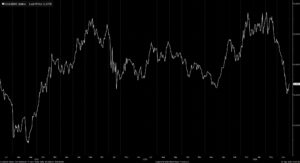
Chart 1: US High momentum top quantile total return sharp drawdown into end of July [2]
The real yield
The steepening of the 2-year/30-year Treasury yield curve in the last week of July reflects growing inflation worries and uncertainty over how the Fed will respond. The fastest AI investment buildout in history is unfolding in a world that is shaped by supply scarcity, with energy constraints, tight labor markets and geopolitical fragmentation. Meanwhile, governments and hyperscalers are drawing on the same pool of savings, intensifying competition for capital. These factors are driving investors to demand higher returns to lend for longer, lifting real yields across developed markets.
Chart 2: 10-year government bond yields across major developed markets, 2010 – 2026 [3]
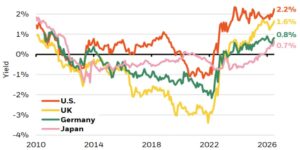
Higher yields have changed the role of government bonds in portfolios and the opportunity set for investors. Bonds have become a less effective portfolio ballast. The correlation between daily US equities and 10-y treasury returns average 7% over the last five years, compared to -43% in the decade prior to Covid. More than 80% of the global bond universe now yields above 4%, versus only 20% in the decade pre-pandemic. Rather than reaching further out the curve, we favor building durable income through short- and medium –
term Treasuries, local currency emerging market debt, selected private credit with resilient cash flows.
Positioning
Against this backdrop, we recommend the following opportunities:
– After the correction, buy leading semi and hyperscaler names for AI exposure, expressed through FCNs in
names like Nvidia, MSFT.
– Favor local currency emerging market debts, expressed through selected EMD funds.
– Long futures positions on Gold and soft commodities such as cotton, rice and sugar
[1] All performance data is sourced from Bloomberg, dated July 31 2026.
[2] Bloomberg
[3] Blackrock Investment Institute, with data from LSEG, dated July 2026.
Disclaimer
The information presented here is intended for Accredited or Institutional Investors only and it does not constitute a recommendation to anyone; it also has not taken into account the specific investment objectives, financial situation or particular needs of any particular person. Information herein is based on sources we believe to be accurate and reliable as at the date it was made. We reserve the right to revise any information herein at any time without notice. No offer or solicitation to buy or sell securities, funds or products and no investment advice or recommendation is made herein. In making investment decisions, investors should not rely solely on this advertisement but should seek independent professional advice. However, if you choose not to seek professional advice, you should consider the suitability of the investment for yourself. Past performance of the fund manager, portfolios, and the funds are not indicative of future performance.
Investment involves risks including the possible loss of principal amount invested and risks associated with investment in emerging and less developed markets. The fund manager, portfolios, and the funds may invest in illiquid instruments, financial derivative instruments and/or structured products and be subject to various risks (including counterparty, liquidity, credit and market risks etc.). Investing in fixed income instruments (if
applicable) may expose investors to various risks, including but not limited to creditworthiness, interest rate, liquidity and restricted flexibility risks. Changes to the economic environment and market conditions may affect these risks, resulting in an adverse effect to the value of the investment. During periods of rising nominal interest rates, the values of fixed income instruments (including short positions with respect to fixed income instruments) are generally expected to decline. Conversely, during periods of declining interest rates, the values are generally expected to rise. Liquidity risk may possibly delay or prevent account withdrawals or redemptions.
Environmental, Social and Governance (ESG) strategies consider factors beyond traditional financial information to select securities or eliminate exposure which could result in relative investment performance deviating from other strategies or broad market benchmarks. Past performance, or any prediction, projection or forecast, is not indicative of future performance. The duplication, publication, extraction, or transmission of the contents, irrespective of the form is not permitted, except for the case of explicit permission by Aevitas Capital Management Pte. Ltd. This advertisement has not been reviewed by the Monetary Authority of Singapore (MAS).