
Key Takeaways
- Relief rally, oil down. A US–Iran interim deal sent Brent down 20.8% and eased stagflation fears; falling yields supported equities and bonds, but precious metals collapsed (gold –11.4%, silver –21.6%).
- Hawkish Fed debut. Strong May payrolls and Warsh’s first FOMC shifted expectations from cuts toward at least one hike this year; the 2-year yield rose on term premium, not inflation.
- Positioning. We manage risk on US semiconductor and memory names, favour defensive banks and industrials, stay opportunistic on gold near USD 4,000–4,100, and add long soft-commodity exposure ahead of a possible “super” El Niño.
Market Overview
Geopolitics remained the market’s centrepiece in June, as a broad wave of relief followed an interim deal signed by the US and Iran. Brent crude fell 20.8% over the month — one of the worst-performing major assets. Easing stagflation pressure pulled bond yields lower, supporting both equities and bonds, but it collapsed prices for precious metals: gold and silver fell 11.4% and 21.6% respectively.
In the US, the S&P 500 and Nasdaq set record highs at the start of the month before rolling over, with the Magnificent Seven broadly lower as investors rewarded semiconductor and memory names over the hyperscalers. The S&P 500 ended June down 0.95% and the Nasdaq fell 2.75%.[1]
The Fed
Kevin Warsh made his first FOMC[2] appearance as Chair this month, setting a distinctly hawkish tone. While reaffirming the 2% inflation target, he declined to offer his own dot-plot projection and stepped back from the usual policy anchors. He also announced five taskforces to review key aspects of central-bank policymaking — market communication, the Fed’s balance sheet, the “use and reliance on existing data sources,” productivity and jobs, and the inflation framework. The review marks a significant internal reform, moving the Fed toward a market-led rather than guidance-led pricing mechanism. Before taking the chair, Warsh had argued that a coming AI-driven productivity boom justified pre-emptive rate cuts; these taskforces look set to test that thesis and pave the way for future rate adjustments. The resulting “hawkish overtones, dovish undertones” lifted the 2-year yield while capping the 10-year, adding uncertainty around risk assets.
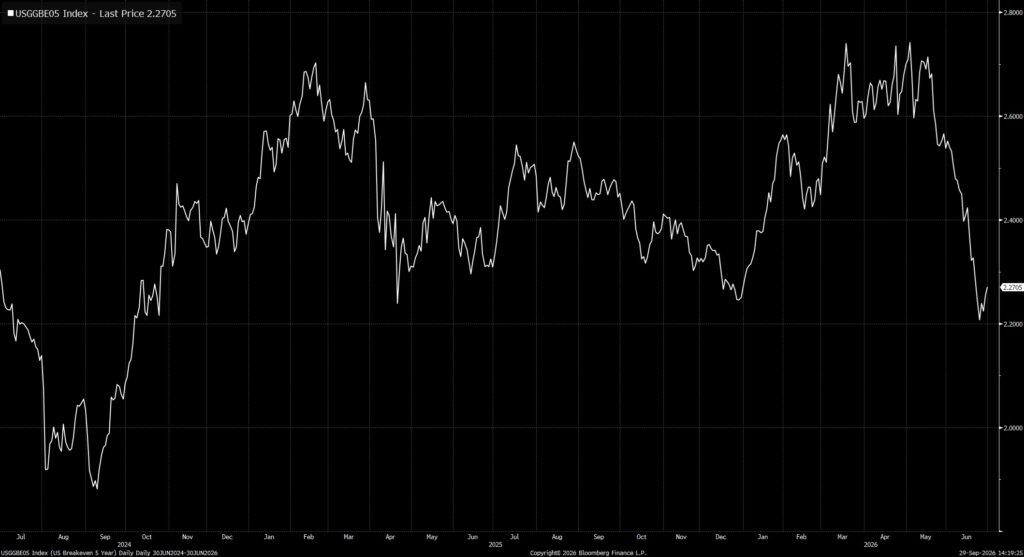
Warsh’s debut raised the possibility of hikes this year, as signalled by the US 2-year yield — though we read that as a higher term premium rather than renewed inflation concern. Falling US 5-year and 10-year breakeven rates, helped in part by lower oil, lend further support to that view.
Chart 1: US Treasury 5-year breakeven rate has fallen from peak [3]
El Niño
El Niño — the periodic global weather pattern associated with warming surface temperatures in the southern Pacific — began in June, according to scientists (NOAA[4], 11 June). It is expected to strengthen into a strong event, with a 63% probability of developing into a very strong “super” El Niño through the 2026–2027 winter. Although El Niño typically recurs every two to seven years, strong and very strong events are rare, occurring just eight times over the past 75 years.
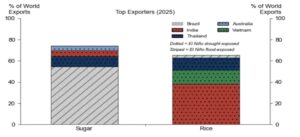
Beyond raising surface temperatures by potentially 2°C or more, this El Niño arrives at a precarious moment: Middle East conflict has left farmers facing sharply higher fertiliser and energy costs, which could further strain agricultural conditions. For crops with more concentrated supply — such as palm oil, rice and sugar — it could weigh on global production and raise the risk of crop export bans, since these growing regions tend to experience drier conditions during El Niño.
Chart 2: Exporters of rice and sugar are concentrated in drought-exposed regions [5]
Positioning
Against this backdrop, we balance risk management with selective, tactical opportunities:
- Manage risk on US semiconductor and memory names, where we expect volatility to rise near term — for example via short-dated put options on Micron Technology, Marvell Technology and Intel, or short-duration fixed-coupon notes with lower knock-out barriers on Magnificent Seven names.
- Favour defensive equity sectors such as banks and industrials, expressed through yield-enhancement notes to participate in the upside of names like Citizens Financial, Citigroup and Caterpillar.
- Opportunistic on gold around 4,000–4,100 USD/oz, and, among base metals, we prefer copper over aluminium and nickel via long or short short-term futures on the respective metals.
- Long futures positions on soft commodities such as cotton, rice and sugar, ahead of potential El Niño-driven supply pressure.
[1] All performance data is sourced from Bloomberg, dated as of June 30 2026.
[2] Federal Open Market Committee
[3] Source: Bloomberg
[4] National Oceanic and Atmospheric Administration
[5] Source: USDA, GS research
Disclaimer
The information presented here is intended for Accredited or Institutional Investors only and it does not constitute a recommendation to anyone; it also has not taken into account the specific investment objectives, financial situation or particular needs of any particular person. Information herein is based on sources we believe to be accurate and reliable as at the date it was made. We reserve the right to revise any information herein at any time without notice. No offer or solicitation to buy or sell securities, funds or products and no investment advice or recommendation is made herein. In making investment decisions, investors should not rely solely on this advertisement but should seek independent professional advice. However, if you choose not to seek professional advice, you should consider the suitability of the investment for yourself. Past performance of the fund manager, portfolios, and the funds are not indicative of future performance.
Investment involves risks including the possible loss of principal amount invested and risks associated with investment in emerging and less developed markets. The fund manager, portfolios, and the funds may invest in illiquid instruments, financial derivative instruments and/or structured products and be subject to various risks (including counterparty, liquidity, credit and market risks etc.). Investing in fixed income instruments (if applicable) may expose investors to various risks, including but not limited to creditworthiness, interest rate, liquidity and restricted flexibility risks. Changes to the economic environment and market conditions may affect these risks, resulting in an adverse effect to the value of the investment. During periods of rising nominal interest rates, the values of fixed income instruments (including short positions with respect to fixed income instruments) are generally expected to decline. Conversely, during periods of declining interest rates, the values are generally expected to rise. Liquidity risk may possibly delay or prevent account withdrawals or redemptions. Environmental, Social and Governance (ESG) strategies consider factors beyond traditional financial information to select securities or eliminate exposure which could result in relative investment performance deviating from other strategies or broad market benchmarks. Past performance, or any prediction, projection or forecast, is not indicative of future performance. The duplication, publication, extraction, or transmission of the contents, irrespective of the form is not permitted, except for the case of explicit permission by Aevitas Capital Management Pte. Ltd. This advertisement has not been reviewed by the Monetary Authority of Singapore (MAS).